
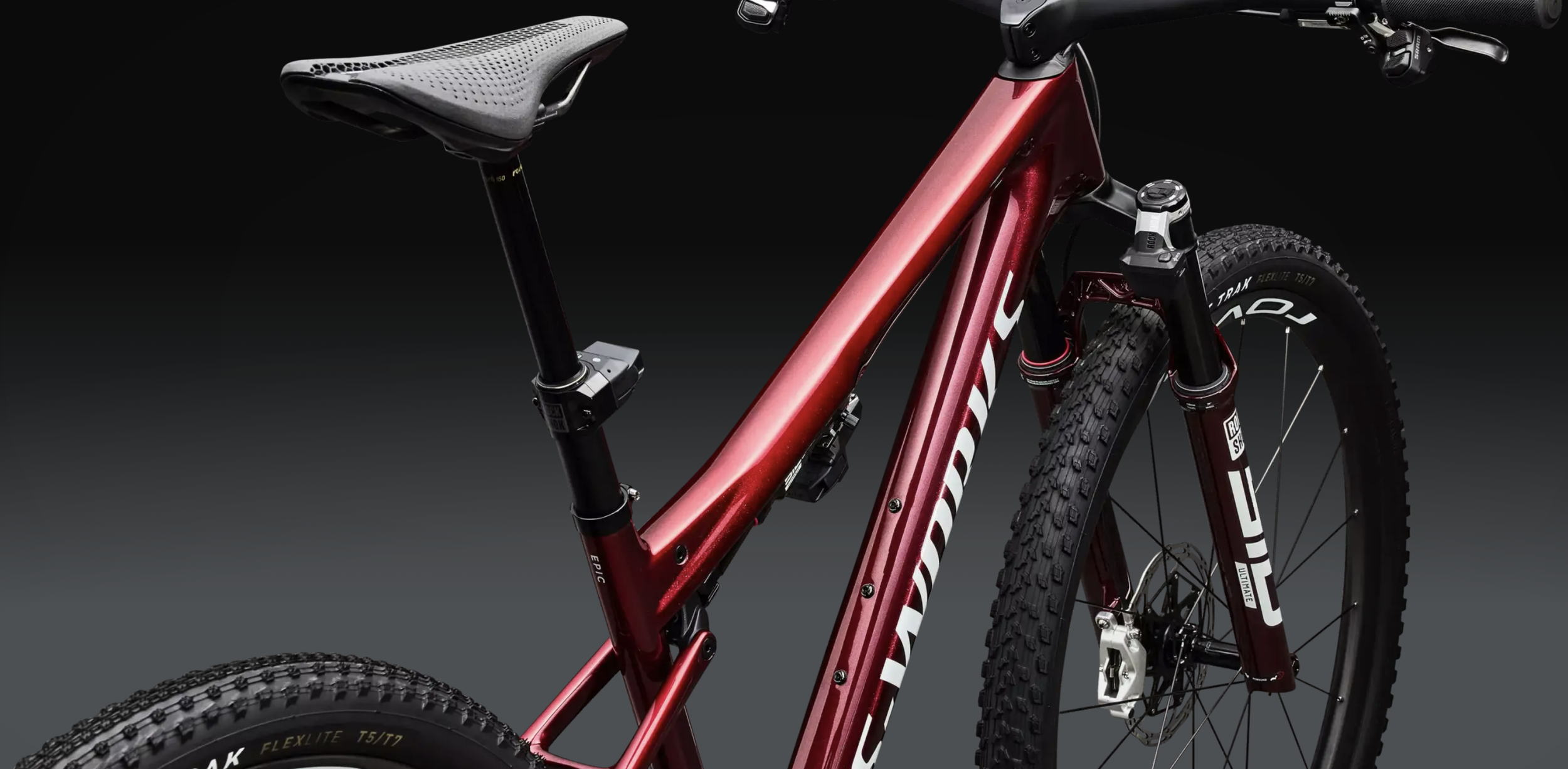
The Epic 9 and the Epic 8 EVO sit closer together on a fit rig than almost any two bikes in Specialized's lineup. In size medium, their reach differs by 5 mm and their stack by 3 mm.
The question I keep hearing in the lab is some version of "Did Specialized just turn the Epic 9 into an EVO?" The honest answer is: partly, and not where most people assume. The Epic 9 picked up a taller front end and a higher bottom bracket that put it right next to the EVO. It also kept the 120 mm fork, a steeper seat angle and a race cockpit that make it an XC bike first.
Here's what the numbers actually say, and what they mean for how each bike fits and rides.
Same frame, nearly
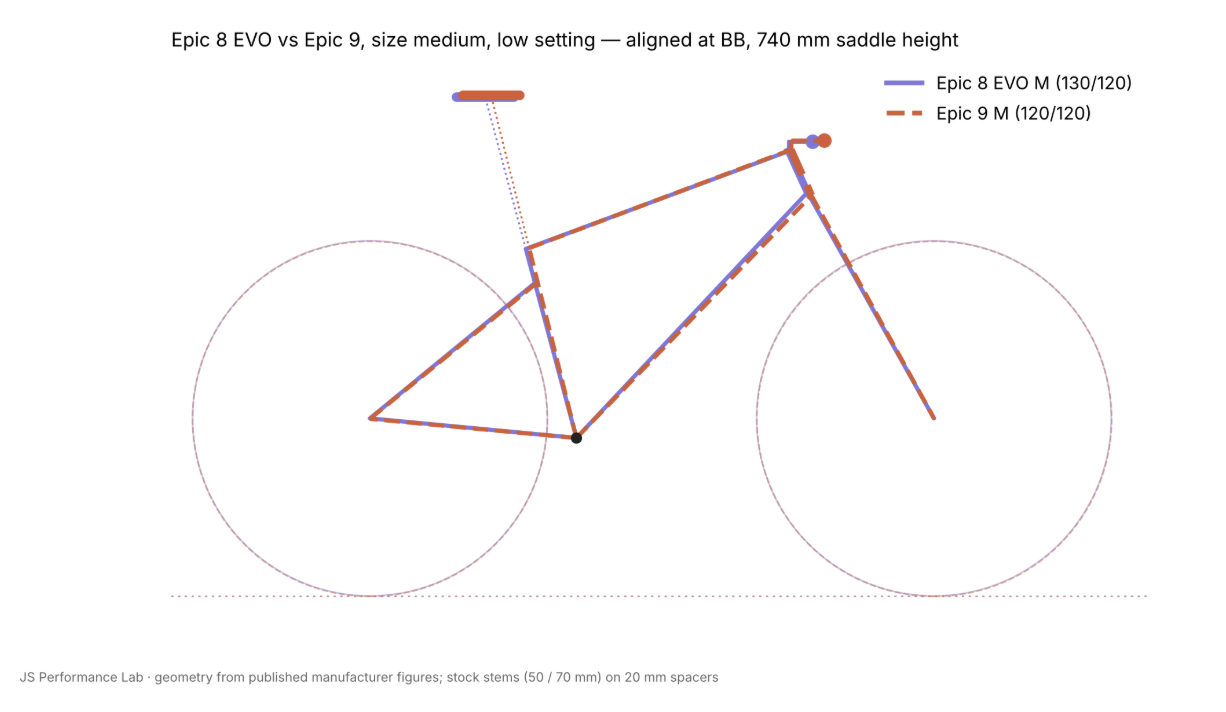
Line the two mediums up at the bottom bracket and they nearly trace the same bike. The solid frame below is the Epic 8 EVO, the dashed one the Epic 9, both in the low flip-chip setting.
Where they match:
Reach and stack: 445/601 mm on the EVO, 450/604 mm on the Epic 9. That's inside the range a spacer or a stem swap covers.
Rear end: both run 120 mm of rear travel on 435 mm chainstays in this size.
Wheelbase: about 1,184 mm on both. The Epic 9's slightly longer reach is offset by the EVO's slacker fork.
Bottom bracket: 40 mm of drop on the Epic 9, 41 mm on the EVO. Pedal clearance and cornering height are effectively the same.
Adjustability: both use a two-position flip chip that moves the head angle about half a degree and the BB about 5 mm.
If you handed a rider each frame with identical cockpits, most couldn't tell you which was which from the saddle.
From Epic 8 to Epic 9: halfway to EVO
The Epic 9 moved toward the EVO in two places and away from it in two others. Here are all three mediums in the low setting:
Toward the EVO. The Epic 9's head tube grew 10 mm, lifting stack 6 mm, past the EVO's. BB drop shrank from 44 to 40 mm, which raises the bottom bracket to EVO height. Both changes make the bike calmer in rough terrain and more forgiving of pedal strikes.
Away from the EVO. The seat angle steepened half a degree to 76°, putting the rider further over the cranks. The Expert build also ships a 70 mm stem, 10 mm longer than the Epic 8's. Specialized dropped the internal SWAT storage to save weight, and one reviewer said they hope Specialized will "sprinkle a little EVO" on the Epic 9.
Unchanged. Head angle and reach are identical to the Epic 8. The trail-friendly front end the Epic 9 is praised for was already there.
So the Epic 9 closed part of the gap to the EVO without trying to become one. Specialized refined the Epic 8 platform, cut 179 g from the frame and sharpened its race position.
The 10 mm that still separates them
The biggest remaining difference is the fork. The Epic 9 stays at 120 mm; the EVO runs 130 mm on the same 120 mm rear travel.
That extra 10 mm does three things:
Slackens the head angle by half a degree, from 65.9° to 65.4°. Steering gets a touch slower and more stable at speed.
Lengthens the fork from about 531 to 540 mm axle-to-crown. The front sits higher under load, so the bike stays more neutral on steep descents.
Adds trail, roughly 117 mm on the Epic 9 versus 120 mm on the EVO. More self-centering at speed, a little more effort in tight switchbacks.
The build kits amplify the split. EVO models pair the longer fork with heavier-duty forks, bigger lugged tires and four-piston brakes. The Epic 9 rolls on lighter race tires.
Keeping the Epic 9 at 120 mm keeps it the efficient, lightweight race bike. The EVO's 130 mm front is what makes it the more capable descender.
Fit notes: which one for which rider
With stock cockpits, the Epic 9 puts you about 12 mm further from saddle to bar than the EVO. Its 1° steeper seat angle moves the saddle roughly 12 mm forward at a 740 mm saddle height. The 70 mm stem then adds back 20 mm over the EVO's 50 mm.
That gap is easy to close. A 50 mm stem on the Epic 9 lands you within a few millimeters of the EVO position, and the reverse works too. Fit shouldn't decide between these bikes; how you ride should.
Choose the Epic 9 if you want the lightest, most efficient bike for fast XC loops, racing or big days with lots of climbing.
Choose the Epic 8 EVO if your trails are rocky and technical, or you want one bike that climbs well and descends with real confidence.
Stuck between them? Bring your current position into the lab and we'll map it onto both frames before you buy.
Happy trails,
Joe