
What Is Cyclic Cluster Dextrin — And Why Does It Matter for Endurance Athletes?
If you've ever bonked mid-run or mid-ride despite drinking your mix religiously, the carbohydrate source in your drink matters more than you think. Not all carbs hit your bloodstream the same way — and cyclic cluster dextrin (CCD) is one of the most significant upgrades the sports nutrition world has made in decades.
The Unique Structure
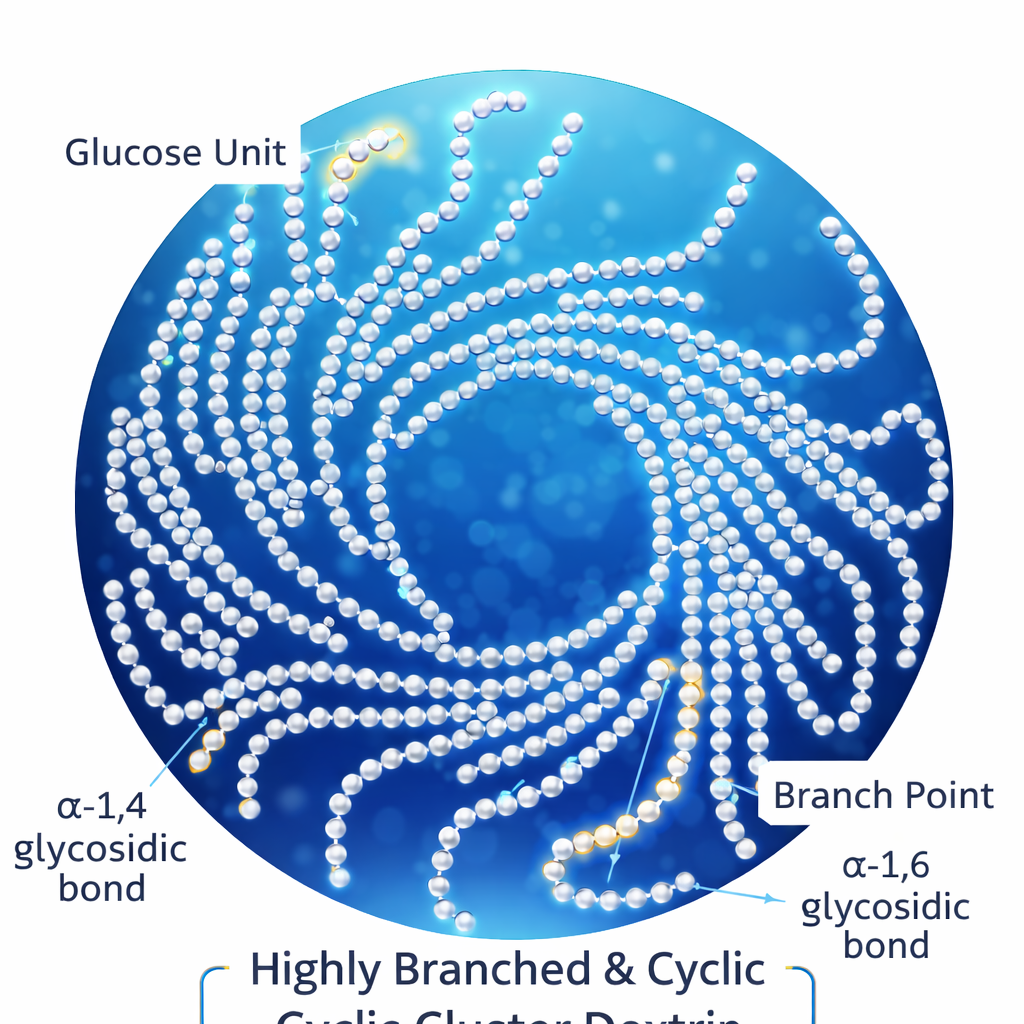
Think of a CCD molecule as a swirling web of glucose molecules. The swirl branches into limbs, those limbs branch into smaller branches, and those branches end in hundreds of individual tips — each tip being a glucose unit your body can use for fuel. Now think of traditional maltodextrin as a single twig: a straight chain of glucose with only two ends.
Your digestive enzymes work like pruning shears — they can only clip tips, not midpoints. With maltodextrin, there are just two tips to clip, so all the glucose floods into your bloodstream in one fast hit. With CCD, there are hundreds of tips across that massive branching structure, so the enzymes chip away steadily over 20–30 minutes, delivering a slow, even stream of glucose rather than a spike.
Why CCD leaves your stomach so fast
This is where CCD separates itself most dramatically from conventional carbs — and it comes down to osmotic pressure.
When you swallow a carbohydrate drink, your stomach acts as a gatekeeper. It won't release fluid into the small intestine until the concentration of dissolved particles in your gut matches the concentration in your blood — a state called isotonicity. Traditional maltodextrin and sugars are small molecules, which means they're highly concentrated in solution and very osmotically active. Your stomach senses this, pumps water in to dilute them, and slows gastric emptying until the concentration equalizes. That's the sloshy, heavy feeling runners and riders know well — your stomach is essentially stalling while it manages the chemical imbalance.
CCD's enormous molecular size changes the equation entirely. Even though you're consuming a high dose of carbohydrates, each individual CCD molecule contributes almost nothing to osmotic pressure — because osmotic pressure depends on the number of dissolved particles, not their size. One massive CCD molecule counts the same as one tiny glucose molecule in osmotic terms, even though it contains hundreds of times more glucose. So your stomach sees a low-concentration solution, doesn't trigger the dilution response, and empties rapidly into the small intestine — where the enzymes get to work breaking down those branches into usable glucose.
For runners, this is particularly meaningful. The repetitive impact of running compresses the gut with every stride, making GI distress far more likely than on the bike. A drink that clears your stomach quickly is one that isn't sitting there getting churned and sloshed with every footfall.
What that means on the trail or road
That rapid gastric emptying combined with the steady glucose delivery curve translates to three real-world benefits for both runners and riders:
Blood glucose stays stable. No spike means no insulin surge, no crash, no sudden energy dip halfway up your climb or at mile 18 of your long run. The fuel arrives when your muscles need it, not all at once.
Your gut stays quiet. Less osmotic disruption means less fluid pooling, less nausea, and less of that heavy stomach feeling that forces runners to slow and riders to back off the effort when intensity climbs.
You can absorb more carbs per hour without GI consequences — which matters when you're deep into a long effort and your glycogen stores are running critically low.
How to dose it
For most endurance athletes, 60 grams of carbohydrate per hour is the sweet spot for efforts lasting longer than 90 minutes — and CCD handles that load far better than conventional carb sources. Here's how to think about it practically:
Start fueling early. Because CCD still takes 30–45 minutes from ingestion to meaningful blood glucose delivery, don't wait until you feel the dip. Begin sipping within the first 20–30 minutes of your run or ride, before your glycogen stores are under pressure.
Sip consistently, don't bolus. CCD works best when you're feeding it into your system steadily — every 15–20 minutes rather than drinking half a bottle at once. Steady intake keeps pace with the enzymatic breakdown rate and maintains that smooth glucose curve.
Scale to duration and intensity. For efforts under 75 minutes at moderate intensity, water and electrolytes are likely sufficient. For efforts pushing past 90 minutes — especially at higher intensities like threshold runs or hard mountain bike rides — aim for 45–60g of carbs per hour. Athletes with well-trained guts doing very long efforts can push toward 80–90g per hour when combining CCD with a small fructose source, since fructose uses a separate intestinal transporter and adds absorption capacity without adding osmotic load.
Mix concentration matters. CCD stays low-osmolality even at higher concentrations, so you don't need to dilute it as aggressively as you would maltodextrin. A standard mix at 6–8% carbohydrate concentration is well tolerated by most athletes — compared to traditional sports drinks which often need to stay at 4–6% to avoid gastric stalling.
Pre-load if you're heading into something long and hard. Taking a serving 30–45 minutes before your run or ride starts the gastric emptying clock early, so glucose is already arriving in your bloodstream as you hit your first real effort.
Where it comes from
CCD isn't a synthetic chemical — it's an engineered carbohydrate developed by a Japanese company called Ezaki Glico, starting from waxy cornstarch. They use a two-step enzyme process to first break the starch into glucose clusters, then fold those clusters into that massive branched structure. It's been commercially available since 2002 and received FDA GRAS status in 2012.
The bottom line
If your current carb source is spiking your energy and crashing it, or causing gut trouble when your effort climbs, CCD is worth a serious look. The science is solid, and for many endurance athletes — whether they're logging trail miles on foot or putting in long hours in the saddle — it's a genuinely different experience. One that lets you fuel aggressively without paying for it later.